One Strange Thing: The Design Rule Every Memorable Hotel Room Breaks
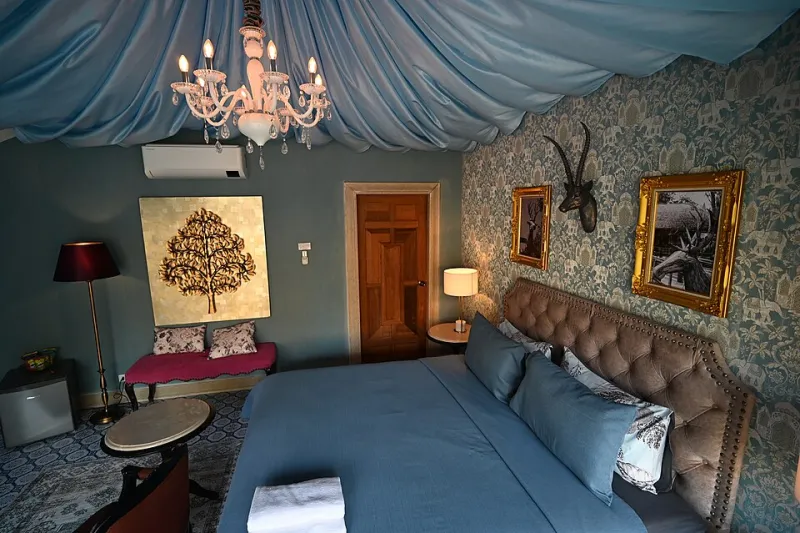
Photo: PattayaPatrol, CC BY-SA 4.0, via Wikimedia Commons
There is a moment, roughly four seconds after you open the door of a hotel room, when you know whether you're going to remember it. Not the thread count. Not the rainfall shower. It's the moment your eye lands on something — a stuffed heron wearing a tiny hat, a chandelier made of old teacups, a bathtub plonked in the middle of the sitting room like it's the most normal thing in the world — and your brain short-circuits pleasantly.
We'd argue this is the single most important second in hospitality. And the industry's obsession with seamlessness is quietly strangling it.
The Tyranny of the Tasteful
Walk into a mid-range British hotel these days and you can play a drinking game: take a sip every time you spot grey wood-veneer flooring, a slogan print above the bed, and a succulent in a concrete pot. You'll be under the table before you've unpacked.
This is what happens when hotels are designed by committee, for nobody in particular. Everything is inoffensive. Nothing is interesting. The room is a shrug in interior form. It photographs fine, sleeps fine, and evaporates from your memory before you've reached the car park.
The rooms that stick — the ones you photograph, the ones you tell your mates about down the pub — all share one trait. They contain exactly one thing that shouldn't work.
The Odd Detail, Defined
We're not talking about chaos. A room with five clashing ideas is a jumble sale; a room with none is a Travelodge. The magic lives in the middle: one confident, slightly bonkers decision that everything else orbits around.
We spoke to designers and hoteliers across the UK about how they find that line, and the answers were refreshingly consistent. The odd detail must be deliberate, not accidental. It must be the first thing you notice, not the fifteenth. And crucially, it must be backed up by proper fundamentals underneath — a genuinely comfortable bed, a decent shower, lighting you can actually read by. Quirk without competence is just mess with a marketing budget.
One designer put it beautifully: the strange object is the room's punchline, and like any good joke, the timing and delivery matter more than the material.
How to Spot a Hotel With a Pulse
Before you book your next UK break, run our quick checklist:
- The website describes rooms individually. If every room is 'Superior King', keep scrolling. If Room 7 has a name and a backstory, you're getting warm.
- There's art, not decoration. Look for actual paintings, prints, or objects with provenance — not bulk-bought canvases of a generic beach.
- The furniture doesn't match. A mismatched vintage chair beside a modern bed is a conversation. A five-piece suite is a formality.
- Something in the photos makes you ask 'why?' If you can't find a single question mark in the gallery, the answer is no.
- The bar has personality. A hotel that gets its bar right usually gets everything else right too.
Why Bother?
Because travel is expensive and life is short, and staying somewhere forgettable is a small, unnecessary tragedy. The odd detail is proof that a human being with opinions made decisions here. It's the difference between accommodation and hospitality.
So next time you check in and spot a bust of a Roman emperor wearing sunglasses, or wallpaper featuring pheasants in formalwear — don't tut. Raise a glass. Somebody, somewhere, stuck their neck out for your entertainment. The least you can do is remember the room.