The Wardrobe That Doesn't Quite Shut: A Field Guide to Hotel Furniture With Opinions
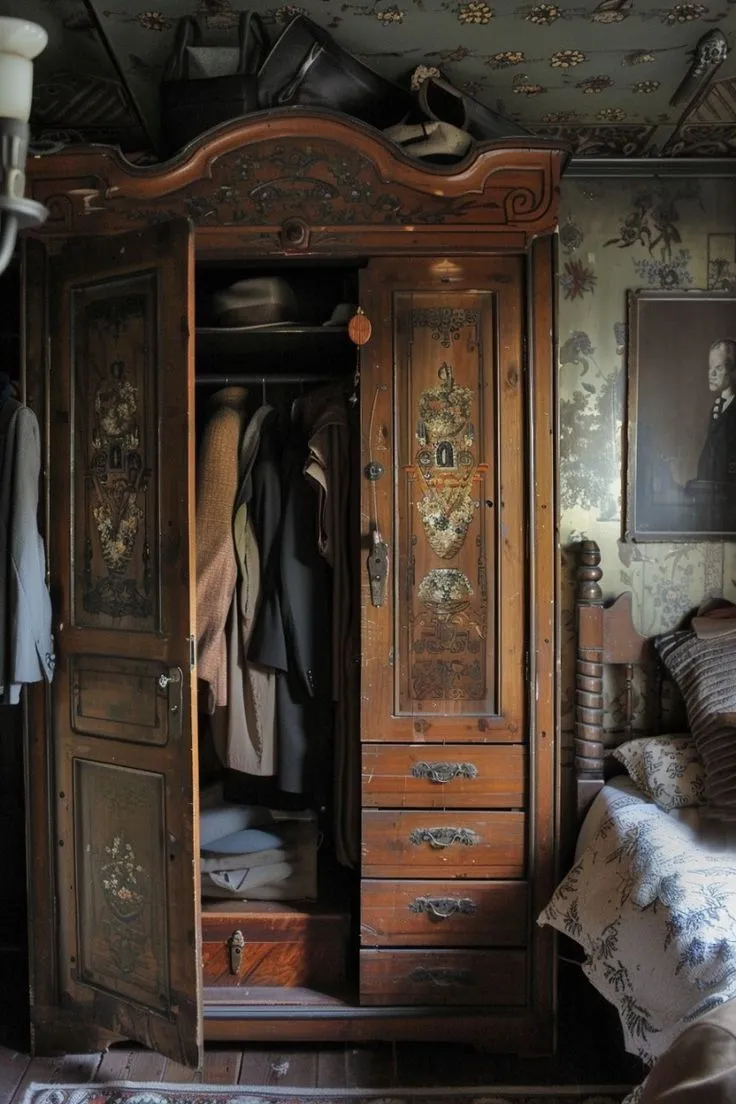
Photo: vintage wooden wardrobe antique hotel room armchair quirky interior, via i.pinimg.com
There is a particular moment, known to every seasoned traveller of Britain's independent hotels, when you open your room door, set down the bags, and make eye contact with the furniture. Not the room — the furniture. Because in a proper hotel, the furniture is not a neutral backdrop. It has arrived. It has history. And in some cases, it has demands.
At the chain hotels, the furniture has been sanded of all personality by a procurement department in Slough. Every bedside table identical, every wardrobe shuts with the muffled, apologetic click of a piece that has never been asked to do anything interesting. It is furniture that has been told, repeatedly, that it must not startle the guest.
In an independent hotel — the sort we deal in, naturally — the furniture has never received that memo. The furniture has a biography. Sometimes several. And so, for the discerning guest, we present a field guide to the characters you will meet.
The Wardrobe That Requires a Hip-Bump
Every grand old hotel has one. A handsome Victorian or Edwardian wardrobe, all dark wood and brass keyholes, that simply refuses to close on the first attempt. You push. It resists. You lean your hip into the lower left corner — the sweet spot, learned on night one — and it settles with a satisfied clunk, like an old man into a good chair.
Is this a flaw? Absolutely not. This is a wardrobe that has absorbed a century of seaside humidity and come out the other side with boundaries. It is testing you. Once you've learned its ways, you're not a guest any more — you're family. Guests at chain hotels never experience this rite of passage. They are poorer for it.
The Armchair That Swallows You Whole
Somewhere in the corner of the room sits an armchair upholstered in a fabric that hasn't been manufactured since the early 1980s — all rust and mustard, possibly with a faint geometric pattern that may once have meant something. You sit down. You keep sitting down. You go down further. Somewhere around the level of the skirting board, you stop, encased, and find you cannot quite get out without a running start.
This chair has opinions about posture and none of them are modern. It has moulded itself around decades of guests — the Sunday papers crowd, the sherry-before-dinner crowd, the one gentleman in 1994 who fell asleep in it and missed his own wedding anniversary dinner. You will read three chapters in that chair and your phone will die unnoticed. It is, objectively, the best seat in the building.
The Bedside Table From a Different Century
Here is where the taxonomy gets interesting. In a well-loved independent hotel, the furniture was not bought; it accumulated. And so you find the bed — perfectly comfortable, sensibly modern, purchased this decade — flanked by a bedside table that is quite clearly Georgian, or at least doing a very committed impression of one.
It has one drawer that works and one drawer that opens with the gentle groan of a hinge that predates the lightbulb. The surface is exactly large enough for a cup of tea and a paperback, and not one inch more, which is the correct amount. Whatever the hotel paid for that little table, it was worth it. It has outlived six owners, two wars and every interior design trend since, and it will outlive the current flat-pack revolution too.
The Mirror That Tells the Truth, Eventually
Not strictly furniture, but it lives in the wardrobe and therefore belongs here. An old mirror — foxed at the edges, slightly dim in the middle — does not flatter you at first glance the way a modern one does. It makes you work for it. But give it a moment, stand back, and you get something a bathroom mirror never offers: perspective. A reflection with a little atmosphere in it. You look like a character in something. This is worth more than perfect lighting.
The Desk That Has Hosted More Drama Than the Telly
The writing desk in the corner, with the wobbly leg and the ink stain nobody has ever managed to remove. Who wrote what at that desk? Love letters, complaints letters, a postcard to Doris in Wigan reading 'weather disappointing, hotel excellent'. The stain is the proof. A desk with an ink stain has been used, properly used, by people who meant it. We'd take it over a glass-tipped 'workspace' any day of the week.
Why Wonky Wins
There is a school of thought — a wrong school — that holds furniture should be invisible, seamless, perfect. But perfect furniture is mute. It has nothing to say because it has never been anywhere. Wonky furniture, furniture with a hip-bump and a grudge and an appetite for guests, is furniture that has lived. It has a biography, and for the length of your stay, you become a chapter in it.
So next time you check in and the wardrobe won't shut, don't ring reception. Lean in. Learn its ways. Somewhere in that small negotiation — you, the furniture, and the last hundred years — is the whole reason we book independents in the first place.