Two's Company, Three's Luggage: The Quiet Glory of Britain's Boutique Lifts
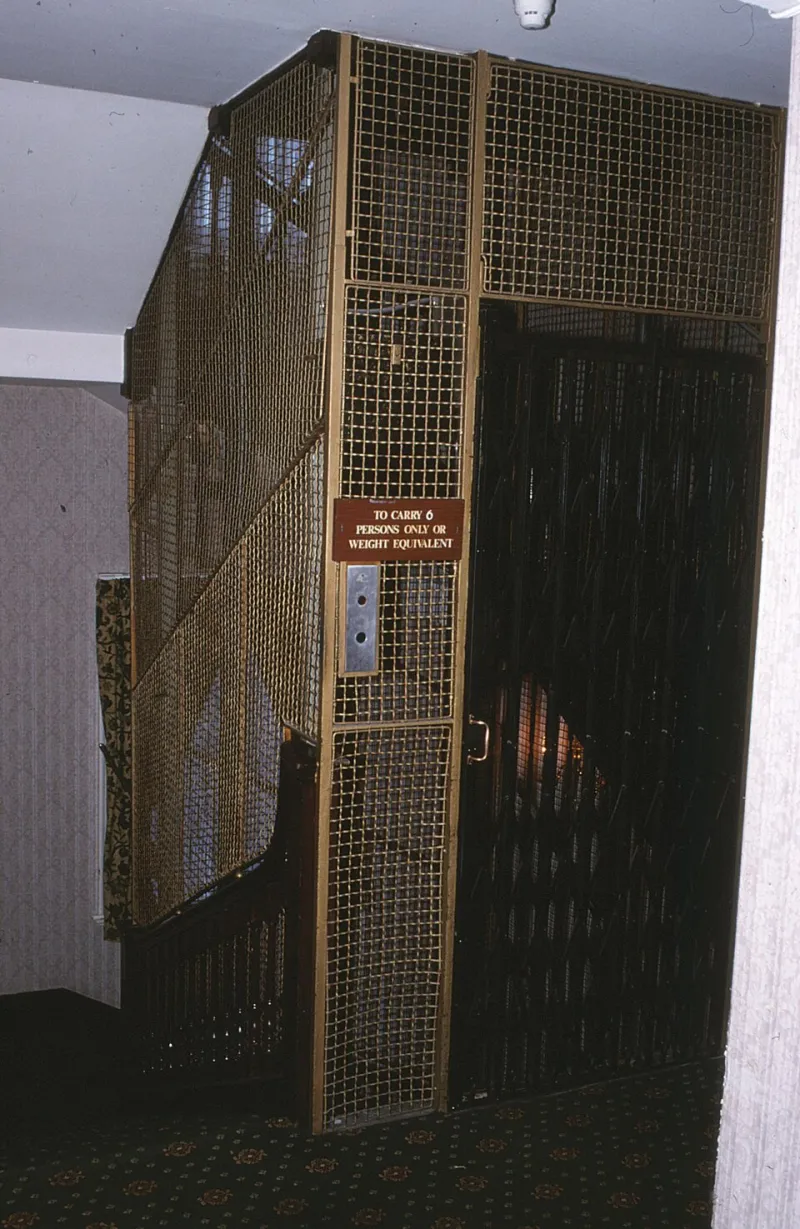
Photo: Jonathan Schilling, CC BY-SA 4.0, via Wikimedia Commons
Every corporate hotel lift in Britain is the same lift. Mirror. Muzak. Buttons lit up like a microwave. You could be in Slough or Singapore and you'd never know the difference. It is a lift with no past, no opinions, and absolutely nothing to say.
Now consider the lift at a proper independent hotel. The lift that fits two and a half people, where the half is your suitcase. The lift that shudders at the second floor like it's remembering the war. The lift with a folding lattice gate you have to wrestle shut, which clanks its way skyward at a pace best described as 'geological'.
We love these lifts. We would die for these lifts. Here's why you should too.
A Lift Is a Time Machine With a Door
The 1930s Otis in a Georgian townhouse hotel isn't really transporting you between floors. It's transporting you between decades. Step in, pull the accordion gate across, press the single brass button, and for eleven slow seconds you are a 1938 commercial traveller with a trilby and a modest expense account.
The Americans got impatient with lifts somewhere along the way and made them faster, smoother, and utterly anonymous. Britain, being Britain, decided that if a machine still works — and even if it only mostly works — then it has earned its keep. Our best hotel lifts have outlived four generations of guests, two world wars and every interior design trend since. They've earned the right to judder.
There's a rule of thumb, we find: the older the building, the more the lift tells you about it. A Victorian hotel's lift is all wrought iron and ceremony. A Sixties conversion has a lift that looks like it should be playing the theme from The Persuaders. A Georgian townhouse, meanwhile, often has no lift at all — just a staircase that doubles as a cardio programme, which is its own kind of honesty.
The Personality Test
Watch how guests behave in a boutique lift and you'll learn everything about them. There are, broadly, four types:
The Historian — photographs the maker's plate, mutters '1927, would you look at that', and rides the lift up and down twice purely for research purposes. Our kind of person.
The Negotiator — attempts to fit a family of four and eleven pieces of luggage into a lift rated for two. Will not be told twice. The lift will have opinions, expressed in the language of grinding cables.
The Flinger — steps through the gate with the casual confidence of someone who has done this before, then spends the whole ascent convinced the floor is about to give way. The lift can smell fear.
The Denier — takes the stairs, every time, on principle. Fine. More lift for the rest of us.
The Mirror Problem
No discussion of British hotel lifts is complete without addressing the mirrors, which appear to have been positioned by someone who had never met a human being. Too low, and you get a loving view of your own midsection for four floors. Too high, and only the tallest guest enjoys the reflection. At precisely the wrong angle, everyone gets a view of the ceiling.
And yet — would you change it? Of course not. A mirror at the wrong height is not a design failure; it's a feature, a small daily comedy performed at your expense by a building that has seen off far savvier critics than you.
A Field Guide to Characterful Rides
You'll find your own favourites soon enough, but a few breeds worth ticking off on your travels:
- The Cage Lift — wrought iron lattice, hand-cranked in spirit even when it's electric, and found in some of Britain's grandest old railway hotels. The Rolls-Royce of the genre, if Rolls-Royces travelled at 0.3mph.
- The Juddering Veteran — post-war, all Formica and strip lighting, with a shudder at every landing that functions as an honest progress report.
- The Cupboard — a lift that technically exists, into which one person and a handbag may be squeezed with effort. Often installed in the 1980s by someone who hated both lifts and people.
- The Resurrected — the beautiful 1930s job that was ripped out in a Seventies refurbishment and lovingly reinstated in the 2010s. Proof that taste, like lifts, sometimes comes back around.
Take the Slow Ride
Here's our modest proposal: next time you check into an independent hotel and spot a lift with a gate, a gauge, or a maker's plate older than your parents — take it. Take it up one floor and back down. Let it clank. Let it take its time.
Because a lift that gets you to the third floor in four seconds flat tells you nothing, and a lift that takes twenty seconds, grinds once at the second landing and delivers you past a mirror set at knee height tells you everything: this building has lived, it has character, and it's not in a hurry — and neither, for the next few days, should you be.