The Long Walk to Room 7: A Field Guide to Hotel Corridors, Landings and Other Forgotten Glories
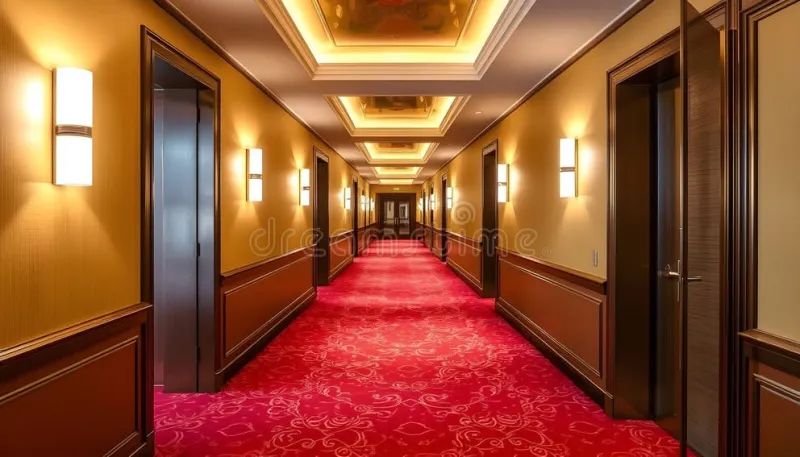
Photo: quirky vintage hotel corridor with patterned carpet and warm lighting, via thumbs.dreamstime.com
We spend an inordinate amount of time agonising over the room itself. Thread count. Pillow menu. Whether the bath is one of those freestanding numbers that requires a small ladder and a waiver. But here's the thing nobody says out loud: you spend, at absolute most, a few conscious minutes in that room before sleep claims you. The corridor? You'll walk it a dozen times. It's the hotel's longest conversation with you, and most of them mumble.
At Oddfellows we have strong opinions about this, because we had to make a hundred small decisions about our own hallways and therefore notice everyone else's. Consider this your field guide.
The First Ten Steps Tell You Everything
The journey from front door to room door is a narrative. The good hotels understand this. There should be a moment — a turn in the staircase, a sudden explosion of clashing wallpaper, a landing with a chair nobody's allowed to sit on — where you think: right, these people have opinions.
The bad hotels give you a beige racetrack. Carpet the colour of weak tea, doors numbered with the enthusiasm of a parking fine, lighting calibrated to make you look like you're appearing in a documentary about shipbuilding. You know the one. Every chain travel lodge from Aberdeen to Portsmouth has it, and it says, clearly and repeatedly: nothing here was decided by a human being.
A Checklist for the Discerning Walker
Next staycation, before you even unlock the door, run the gauntlet:
- The floorboards test. A gentle creak is character. A floor that slopes like the deck of a trawler is heritage. A floor that's perfectly level, laminated and grey is a warning.
- The smell audit. Old buildings have a smell — beeswax, log fires, a whisper of history. This is good. A lobby diffuser pumping out 'Fresh Linen Breeze' is the olfactory equivalent of a stock photo.
- The artwork question. Is there one strange picture on the wall? A portrait of somebody nobody can identify? Excellent. Ten identical botanical prints in matching frames? Someone bought 'art' by the metre.
- The landing situation. A proper British hotel has a landing with something on it. A grandfather clock that's wrong twice a day. A taxidermy pheasant with attitude. A sagging chesterfield that has heard things.
- The window at the end. Corridors that end in a window with a view are the work of people who care. Corridors that end in a fire door are the work of people who have read regulations.
In Defence of the Wonky Stairwell
Lifts are efficient and lifts are boring. The stairwell of a good British hotel is a museum you get to climb through — brass banisters worn smooth by a century of hands, a stained-glass landing window, a fire bucket that hasn't seen action since the Blitz but remains on standby, just in case.
Yes, your suitcase will suffer. Yes, you'll arrive at your room faintly perspiring. You'll also have earned your G&T, and you'll know the building in a way no lift passenger ever will.
The Key Card Moment
When you finally get the door open, notice how you feel. If the corridor promised character and the room delivers, congratulations — you've found a hotel run by people, not a spreadsheet. If the corridor promised character and the room is an identikit pod, you've found a hotel that dressed up for the photograph and changed back into joggers the moment you arrived.
The walk matters. It's the overture, the trailer, the first paragraph. And any hotel worth its flock wallpaper knows that the journey to the room should be almost as memorable as collapsing into it. Almost.